

The Absence of Blur: HEDDphone D1’s Honest Clarity
The respected German engineering brand HEDD Audio has reached out to the earphonia.com team to experience their D1 headphone.
We are certainly keen to see what the worlds’s first Thin-ply Carbon Diaphragm (TPCD) headphone is capable of.
HEDDphone® D1
$799
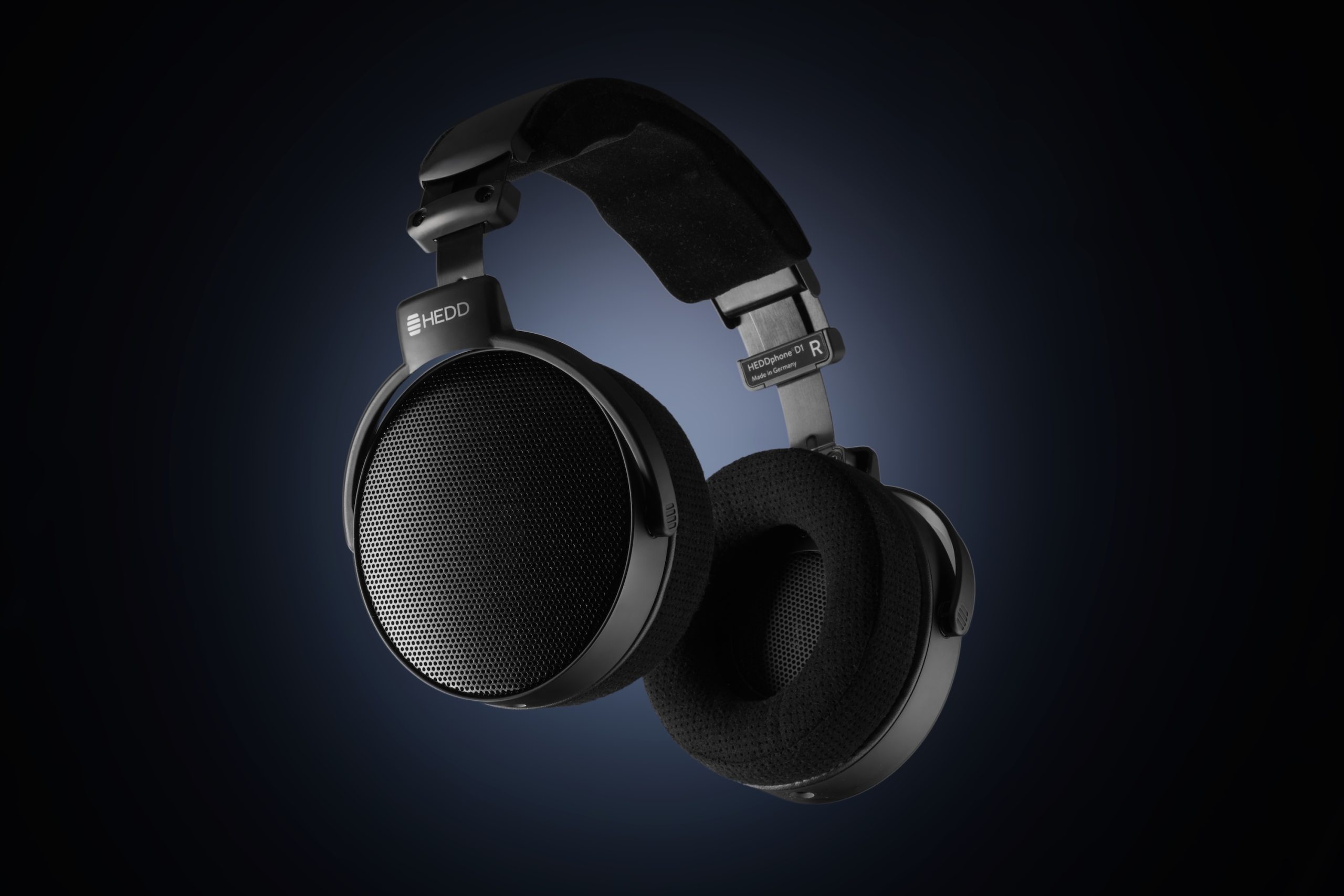
I remember the first time I put the HEDDphone D1 on the desk. It didn’t announce itself. No polished slogan, no chrome bravado. Just a measured honesty: an open-back headphone that seemed more interested in the work than the spectacle. That feels right for HEDD.
The company’s story begins not with hype but with a family conversation—physicist Klaus Heinz working alongside his son and musicologist Dr. Frederik Knop. Berlin is full of those conversations—the patient ones that turn into design—and the HEDDphone D1 is very much a Berlin object: practical, precise, and quietly daring.
You feel that as soon as you lift it. Three hundred and fifty grams is a number, but in the hand it’s a promise that long nights won’t leave a mark on the crown of your head. The pads—perforated velour—breathe like good linen. The yokes and cups don’t creak for attention. Two textile-covered cables sit coiled beside the carry case, their dual 3.5 mm mono connectors clicking home with the assurance of engineering that’s been proofed by a stubborn mind. There’s a 6.35 mm adapter in the box because someone at HEDD knows that half of the world’s sacred sounds still travel through quarter-inch.
Here is where the HEDDphone D1 steps out of the ordinary: the way it treats precision as a kind of hospitality. Studio grade, in this context, isn’t a banner—it’s a behaviour. The diaphragm’s Thin-Ply Carbon doesn’t merely extend bandwidth; it disciplines motion so thoroughly that the music resolves into decisions rather than effects. You can point to the mic choice on a vocal because the sibilance reads like the edge of a capsule, not a smear of brightness; you can hear the slope of a high-pass filter because the bass retains pitch as it fades, instead of blooming into a soft fog.

Precision is not the spotlight here—precision is the absence of blur, the way a landscape looks when mist lifts and you suddenly notice the stone fence running through the field. That clarity invites you in, not to marvel at detail for its own sake, but to follow the thread of intention from the control room to your chair.
But the detail that lingers is the one you can’t see: a diaphragm cut from Thin-Ply Carbon—TPC, the material that keeps Formula 1 cars honest at 300 km/h and made NASA’s Mars helicopter light enough to dance on another planet’s thin air. TPC is not a gimmick; it’s a laid-up architecture of ultra-thin carbon layers, aligned and bonded until stiffness and mass strike a compromise that feels like a cheat code.
Most dynamic drivers need bandages—damping glues, fibers, tricks—to hush their resonances. The D1’s diaphragm—TPCD, Thin-Ply Carbon Diaphragm—solves the problem at the bone. Structural resonance control is such a clinical phrase for something so musical, but it’s the heart of this headphone: less internal noise, less lag, fewer apologies between the signal and your ear. Transients don’t just arrive; they arrive on time.
Clarity, the kind that earns the word, depends on speed followed by stillness. The HEDDphone D1’s speed is not about treble shine or that brittle “hi-fi” sting—it’s the rapid rise to the note and the equally rapid return to silence. When a sound begins, it begins; when it stops, it stops. That clean punctuation is what turns information into music: the tail of a room reverb sits behind a vocal instead of spilling into it; a finger slide on a string reads as motion, not hiss; a kick and a bass guitar can share the first millisecond without stepping on each other’s shoes.

You realize, after a while, that “clarity” here is really the ear’s relief at not having to sort through leftovers.
The recording stands upright on its own legs….
Across the spectrum, all is kept honest. The HEDDphone D1 treats the frequency ranges like rooms in the same house—separate, but connected by doors that never slam.
Down low, bass is taut and articulate; it arrives with contour and then let’s go, so you feel the note’s core rather than a cloud of afterthought. There’s impact when the track calls for it, but never the kind that leans on you—weight carried with posture.
The midrange is the home of meaning, and the D1 keeps it unadorned in the best sense: voices have body without syrup, guitars carry wood and wire, pianos retain both hammer and soundboard. You hear vowels and consonants cooperating instead of competing.

Up top, the treble is a sheet of clear glass—crystalline but not brittle. Cymbals disclose their metal grain; strings show their air; the sparkle lives in texture, not glare. Taken together, the ranges meet without overlaps that smear or gaps that starve: a cohesive, calibrated balance that stays true at whisper levels and at living-room bold.
HEDD didn’t stumble into this.
The HEDDphone D1 was a stubborn idea for eight years—an argument carried across e-mails and prototypes and coffee, between Berlin and Sweden, where Composite Sound have made a craft of ultralight, high-stiffness diaphragms.
This is what collaboration looks like when ego gets out of the way: a German insistence on repeatable precision meeting a Swedish obsession with carbon that wants to move like silk and stop like stone.
The result is a dynamic driver that behaves, in the best moments, like a miniature loudspeaker: the clarity and force of a studio monitor compressed into something intimate enough to hear your own breath between tracks.

If you’ve lived with HEDD’s speakers, you’ll recognize the sensibility.
The HEDDphone D1 is not trying to be pretty. It’s trying to be right. Which is its own kind of beauty.
Then there’s immersion, the quiet kind that shows up when accuracy stops drawing attention to itself. The open-back architecture gives you width, yes, but the more important thing it gives you is stability—the image holds still.
Center vocals are where they should be even at low volumes, panned guitars inhabit their lanes without drift, overheads float rather than hiss. It’s like sitting in a well-set control room: you forget to analyze because nothing is trying to be persuasive. The record unrolls at its own speed and your body follows; your shoulders drop; you start noticing pacing and narrative in albums you thought you’d exhausted years ago.
Immersion here isn’t a trick of booming bass or hyped air. It’s the consequence of knowing exactly where everything is, all the time. Impressive!!!
You don’t have to build an altar to amplification to enjoy it. With a 32 Ω impedance and 100 dB sensitivity, the HEDDphone D1 laughs gently at the notion that fidelity must be fragile.
Plug it into the kind of careful portable DAC that lives in a jacket pocket and you’ll get the point immediately—speed, an easy top end that doesn’t saw, bass that behaves like tense fabric rather than pumped rubber.
Give it headroom—an honest desktop amp with clean current—and the stage lifts, not dramatically, but with that incremental dignity that convinces you this headphone is scaling with you, not showing off at your expense.
I like that modesty.
The HEDDphone D1 doesn’t turn louder when you upgrade the chain; it turns truer.


