

Sendy Audio Apollo Pro Review: Detailed Planar Sound
The Sendy Audio Apollo Pro delivers wide imaging, deep bass and smooth treble without becoming aggressively bright or tiring. This open-back planar magnetic headphone is designed for focused listening at home, where its controlled low end, natural midrange and spacious presentation can be appreciated properly.
Sendy Audio Apollo Pro Review
£449
Its strengths become clearer over time. Bass extends impressively low, instruments remain easy to separate and the treble reveals ambience and decay without adding a brittle sheen. Physical bass impact is more restrained than some listeners may expect from a £449 headphone, while vocals sit within the soundstage rather than directly in front of the listener.
As an open-back design, the Apollo Pro leaks substantial sound and provides very little isolation. It is unsuitable for commuting, shared offices or late-night listening beside someone trying to sleep. For home listeners who value soundstage, tonal balance, separation and long-session comfort over maximum slam, however, it is a strong option.
Sendy Audio Apollo Pro pros and cons
Pros
- Wide and accurately organised soundstage
- Deep, controlled bass extension
- Natural and full-bodied midrange
- Detailed treble without persistent sharpness
- Excellent instrument separation
- Comfortable during long listening sessions
- Distinctive zebrawood and metal construction
- Strong performance for films and gaming
Cons
- Bass impact could be stronger
- Vocals can sound slightly distant
- Open-back design leaks substantial sound
- No integrated microphone
- Requires a reasonably capable source
- 4.4mm cable and adaptors can feel bulky
- Strong competition at this price
Design and build quality
The Apollo Pro prioritises space, separation and tonal restraint. It is a wired, open-back headphone intended for a desk, listening chair or dedicated hi-fi system. It offers almost no passive isolation and makes no serious attempt to be portable. That is not a flaw in itself; it simply defines the intended use.
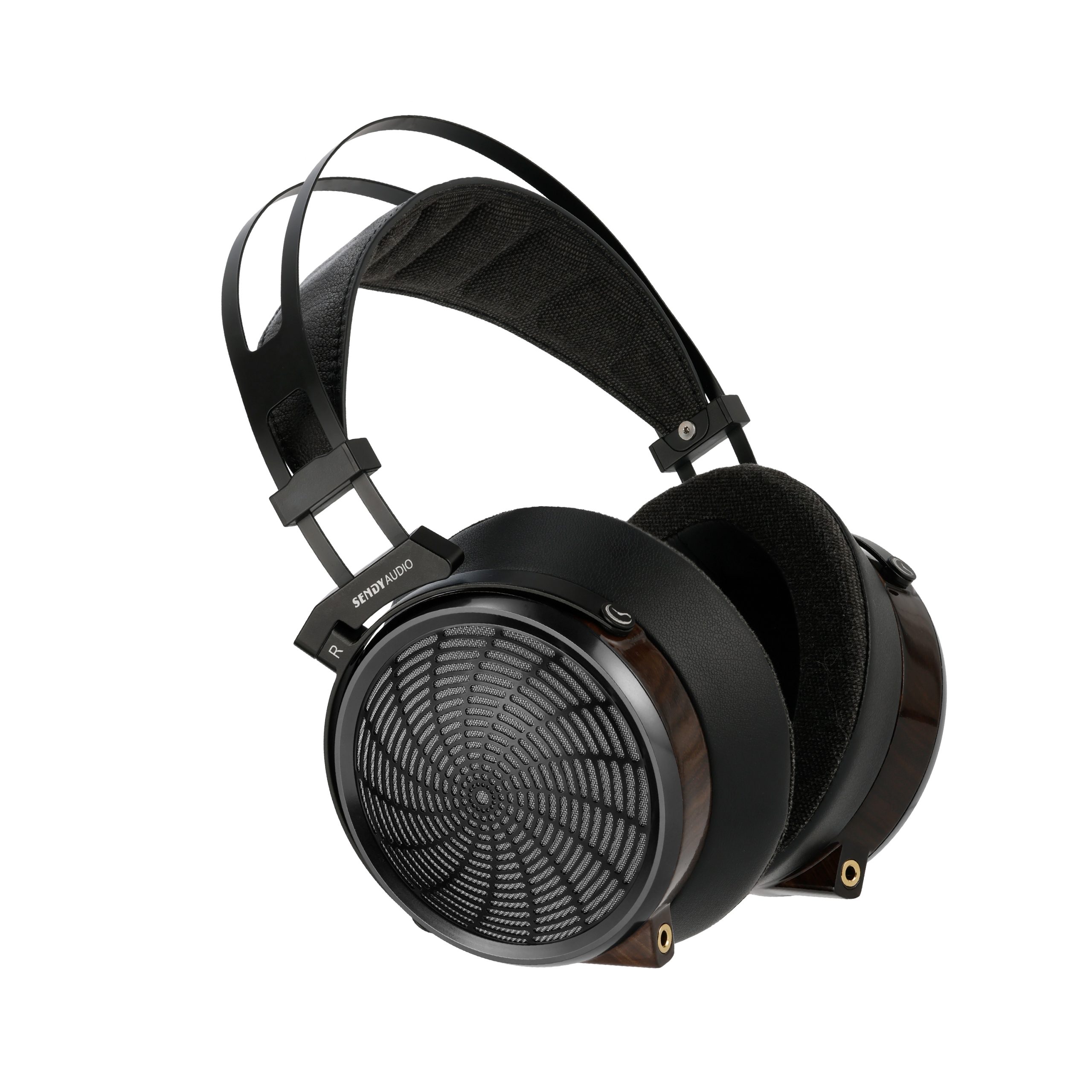
The zebrawood ear cups are its most distinctive visual feature. Natural grain variation means each pair will look slightly different, while the sunburst metal grilles give the headphone a recognisable identity without relying on oversized branding.

The overall design looks more like traditional hi-fi equipment than studio gear. Wood, exposed metal and large circular cups give it a decorative appearance, but it stops short of becoming excessive.
The aluminium components are CNC-machined, and the adjustment mechanism feels smooth and substantial. The cups articulate enough to settle around the head without prolonged adjustment, while nothing on the review sample felt loose, unfinished or incorrectly fitted.
The exposed grilles are vulnerable to dust and accidental knocks, so the Apollo Pro should not be carried loose in an unpadded bag. The zebrawood finish may also show skin oils, small marks and surface wear over time. Some owners will regard that as natural ageing; others may prefer to clean the cups regularly.
In the hand, the Apollo Pro feels appropriately premium for the price. It achieves that without unnecessary weight or elaborate mechanical features.
Comfort and fit
Comfort is one of the Apollo Pro’s stronger qualities. The clamping force keeps the headphone secure without pressing excessively around the jaw, while the broad headband distributes weight effectively and avoids creating a concentrated hotspot at the crown.
The velvet-covered pads are soft and more breathable than many synthetic-leather alternatives. They can still become warm during long listening sessions, particularly in a hot room, but this is common with thick over-ear pads.
At 354g, the Apollo Pro is reasonably light for a large planar magnetic headphone. More importantly, the weight is distributed well. The cups do not drag downward, and the headband does not press a narrow line into the scalp.

The pads should provide enough depth for a wide range of ear sizes, and the cups move sufficiently to create an even fit without constant repositioning. No headphone fits everyone, however. Larger heads may experience more clamp, while smaller heads may find the cups visually oversized.
For most listeners, the Apollo Pro should remain comfortable through several albums, a long film or an extended gaming session.
Driver technology
Each ear cup contains a custom 78mm planar magnetic driver. Sendy Audio states that the composite diaphragm is less than 800 nanometres thick, with aluminium circuitry applied directly to its surface using an Electron Beam Evaporation Deposition process.
The terminology is complicated, but the basic principle is straightforward. A very thin diaphragm with a conductor distributed across its surface can move rapidly and consistently, which can support clean transients, strong separation and controlled low-frequency behaviour.
Specifications alone do not guarantee good sound. Pad design, magnet geometry, cup volume, acoustic damping and tuning all influence the final result. In the Apollo Pro, however, the driver behaves well. Bass notes stop cleanly, dense arrangements remain organised and instruments occupying similar frequency ranges stay distinct.

Amplification and source matching
The Apollo Pro has a stated impedance of 27 ohms and a sensitivity of 93dB. It can reach practical listening levels from many portable DACs and headphone amplifiers, although it benefits from a source with reasonable current delivery and some available headroom.
A capable dongle DAC should be sufficient for normal listening. A good desktop amplifier can give dynamic peaks more breathing room and make the low frequencies feel slightly firmer on demanding recordings, but the Apollo Pro does not require unusually high power.
A weak laptop output or inexpensive phone adaptor may still make the headphone loud enough, but bass can lose definition and larger dynamic shifts may sound flatter. The Apollo Pro is therefore not especially difficult to drive, though it should be paired with a competent source before its sound quality is judged.

Cable and connectivity
The supplied detachable cable terminates in a 4.4mm balanced plug. Sendy Audio includes 3.5mm and 6.35mm adaptors, allowing the Apollo Pro to connect to most portable DACs, headphone amplifiers and conventional audio equipment.
The adaptors are functional but add bulk at the source end. A separate 3.5mm cable would have been cleaner for laptops and portable devices, as the adapted plug assembly becomes relatively long.
Sendy Audio highlights the cable’s conductor mix, but the practical qualities matter more: it is detachable, feels durable, produces little handling noise and remained securely connected throughout testing.
Sound quality
Overall presentation
The Apollo Pro sounds spacious, controlled and highly detailed. Its tonal balance is restrained, with no exaggerated bass shelf, aggressive upper-midrange emphasis or sharp treble boost designed to create an immediate showroom effect.
This can make the headphone seem slightly uneventful during a short demonstration. After a longer session, its advantages become clearer. Bass lines remain clean, instruments hold their positions and the treble reveals room ambience without spreading a brittle sheen across the recording.
The soundstage is wide, but the presentation remains cohesive. Instruments have space around them without feeling artificially separated. The overall effect is detailed without being clinical and open without becoming thin.

Bass
Sub-bass extension is excellent. Deep electronic tones, low orchestral notes and film effects retain weight well into the lowest frequencies. The Apollo Pro reaches low enough to reproduce substantial depth without relying on an inflated mid-bass response.
Bass quantity is relatively restrained. It sits at a balanced level within the mix and does not spread upward into the lower midrange. Individual bass lines remain easy to follow, even when several low-frequency layers are present.
Texture is another strength. A bowed double bass sounds clearly different from an electronic sub tone, while changes in decay and playing technique remain audible. Kick drums have a clean and clearly defined leading edge.
Physical impact is less convincing. Some dynamic-driver headphones and bass-emphasised planar models deliver a stronger central thump, particularly with hip-hop, dance music and heavily compressed electronic tracks. The Apollo Pro has the extension, but not always the physical slam.
Midrange
The midrange is one of the strongest parts of the Apollo Pro’s tuning. Voices have enough weight to avoid sounding thin or papery. Male vocals retain chest resonance, while female voices remain open without developing a brittle upper edge.
Vocals are positioned within the soundstage rather than pushed closely towards the listener. This works particularly well with live albums, orchestral recordings and large-scale productions, although smaller acoustic tracks can lose a little intimacy.
Piano sounds convincing because the initial attack is supported by enough body and resonance. Strings avoid the polished, glassy character sometimes associated with brighter planar headphones, while acoustic guitars retain clean leading edges without becoming disconnected.

Treble
Treble is extended, airy and mostly smooth. Cymbal decay, room reflections and quiet reverb trails are easy to identify, yet the Apollo Pro presents this information without creating a permanent bright haze.
Poorly mastered recordings can still become sharp at high volume, especially when they contain aggressive cymbals or excessive upper-midrange compression. The Apollo Pro does not hide these flaws; it simply avoids emphasising them more than necessary.
Compared with brighter planar headphones, it sacrifices a small amount of sparkle and immediate excitement. In return, it is easier to tolerate during long listening sessions.
Soundstage, imaging and separation
The Apollo Pro produces a wide soundstage with a stable centre and convincing depth. Recordings with strong spatial information can extend beyond the edges of the ear cups, while tightly panned studio recordings remain appropriately compact.
Imaging is precise. Instruments remain fixed in position, movement from left to right is easy to track and the centre image stays stable rather than collapsing into an indistinct gap. Front-to-back layering is also effective, although width is the first quality most listeners will notice.
Instrument separation is excellent. Busy rock recordings retain individual guitar parts, orchestral crescendos remain readable and layered electronic tracks preserve their structure even when several textures occupy similar frequency ranges.

Dynamics
Small dynamic changes are reproduced very well. Variations in vocal pressure, drum technique and orchestral phrasing have enough gradation to keep performances expressive.
Larger shifts also have reasonable scale, but the Apollo Pro’s main weakness is physical impact. Percussion strikes are fast and clearly outlined, yet they can lack the final sense of force delivered by the strongest dynamic-driver alternatives.
This is consistent with the headphone’s broader character. It remains composed and organised when music becomes loud or crowded. Listeners who value speed, separation and control are likely to appreciate that approach; those who prioritise slam should compare it directly with a good dynamic-driver model.
Films and gaming
The Apollo Pro performs very well with films. Its wide presentation gives soundtracks room to expand, while the deep bass extension adds weight without overwhelming dialogue. Environmental effects, score elements and mechanical sounds remain separated during busy action scenes.

Gaming performance is similarly strong. The wide soundstage helps large environments feel open, while accurate imaging makes footsteps, environmental sounds and directional effects easy to locate.
The Apollo Pro does not include a microphone, so multiplayer users will need a separate USB, desktop or attachable mic. It also leaks substantial sound and allows outside noise to enter freely, making it best suited to a quiet, private room.
Everyday ownership
The Apollo Pro is a passive wired headphone. There is no battery to degrade, no companion app to lose support and no firmware update capable of changing its behaviour unexpectedly.

The detachable cable can be replaced if it fails. The pads will eventually compress and wear, which may affect both comfort and sound quality, so replacement-part availability is worth checking before purchase.
The wooden cups and exposed grilles require some care. Dust will accumulate and the finish may develop small marks. A headphone stand or protective case is sensible, particularly in homes with children, pets or limited desk space.

The largest practical limitation remains the open-back design. Music leaks clearly into the room, while nearby conversations, traffic and television audio remain audible.
- Not suitable for commuting
- Not suitable for shared offices or libraries
- Poor choice for noisy rooms
- Unsuitable for late-night use beside a sleeping partner
Value
At £449, the Apollo Pro delivers strong sound quality, good comfort and a distinctive build. The zebrawood cups, detachable cable and included adaptors create the impression of a carefully assembled product rather than a basic frame built around a capable driver.
Several established planar headphones compete at a similar price, while sales can bring more expensive alternatives into direct competition. Some rivals offer brighter treble, stronger bass impact, more intimate vocals or easier amplification.
The Apollo Pro justifies its price through a combination of smooth but detailed tuning, wide imaging, excellent separation, long-session comfort and distinctive natural-wood construction. It is competitive at its standard price, though it is not an obvious bargain.

Alternatives to consider
HIFIMAN Ananda Nano
The HIFIMAN Ananda Nano is a strong alternative for listeners seeking a large soundstage, high clarity and a more energetic top end. It can sound more immediately impressive during a short comparison, while the Apollo Pro offers smoother treble and a less clinical presentation.
Audeze MM-100
The Audeze MM-100 is more functional and studio focused, making it a logical choice for monitoring, editing and analytical work. The Apollo Pro feels more decorative and spacious, with a presentation better suited to relaxed home listening.
Original Sendy Audio Apollo
The original Apollo remains relevant for listeners who prefer a warmer and fuller sound. The Apollo Pro is more open and precise, with cleaner bass and clearer instrument separation, although some owners may miss the older model’s richer and darker presentation.
Dynamic-driver alternatives
Dynamic-driver headphones at this price can offer stronger bass punch, more intimate vocals and easier amplification. The Apollo Pro generally performs better in low-end control, separation and spatial organisation. The better choice depends on which qualities matter most.
Who should buy the Sendy Audio Apollo Pro?
The Apollo Pro is best suited to listeners who want:
- Deep bass extension with tight control
- Natural vocal and instrumental tone
- A broad soundstage
- Stable and accurate imaging
- Strong instrument separation
- Detailed treble without constant sharpness
- Good comfort during long sessions
- A premium open-back headphone for home use
It is less suitable for listeners who need:
- Heavy physical bass impact
- Close and strongly projected vocals
- A bright, highly explicit treble balance
- Isolation in noisy or shared spaces
- Wireless connectivity
- An integrated microphone
- A highly portable headphone
- The least expensive planar magnetic option
Final verdict
The Sendy Audio Apollo Pro is a highly capable open-back planar magnetic headphone. It combines deep bass extension, a convincing midrange and a broad, accurately organised soundstage. Its treble reveals plenty of detail without making every recording sound harsh or brittle.

Its greatest strength is how rarely it interferes with the listening experience. Bass remains controlled, instruments stay separated without losing cohesion and imaging is precise enough for critical listening and gaming.
It does hold back in some areas. Bass impact could be stronger, vocals may feel slightly distant and large dynamic moments lack the physical force delivered by the best dynamic-driver alternatives.
The open-back design also restricts the Apollo Pro to quiet, private spaces. At £449, buyers should compare it carefully with brighter planar models, studio-focused alternatives and dynamic-driver headphones with greater punch.
Even within that competitive market, the Apollo Pro has a clear identity. It is spacious, comfortable, carefully tuned and properly built. It is best suited to home listeners who value tonal balance, soundstage and strong detail but do not want every listening session to feel like a technical examination.
Frequently asked questions
Is the Sendy Audio Apollo Pro open-back?
Yes. It uses an open-back design, leaks a large amount of sound and provides very little isolation from external noise.
Can the Apollo Pro be used for commuting?
It is not recommended. Other passengers will hear the music, while announcements, traffic and surrounding conversations will remain clearly audible.
Does the Apollo Pro need a headphone amplifier?
It can work with a capable portable DAC or dongle, but a weak laptop or phone output may reduce bass control and dynamic performance. A competent portable or desktop amplifier is preferable.
Is the Apollo Pro good for bass?
It provides excellent sub-bass extension, texture and control. Its physical bass impact is more restrained than some dynamic-driver or bass-emphasised headphones.
Is the Apollo Pro good for gaming?
Yes. Its wide soundstage and accurate imaging make positional cues easy to follow. It does not include a microphone, so a separate mic is required for voice chat.
Is the Apollo Pro comfortable for long sessions?
For most listeners, yes. Its 354g weight is distributed effectively, while the broad headband and velvet-covered pads support extended use.
Is the Sendy Audio Apollo Pro worth £449?
It is competitive at £449 for listeners who value soundstage, detail, comfort and premium construction. Buyers seeking maximum bass impact or the lowest possible price may find better alternatives.


